
Defence Minister Rajnath Singh assures India's energy security amidst West Asia tensions, highlighting naval protection of tankers and readiness to counter cross-border terrorism.

An Indian-flagged crude oil tanker, Jag Laadki, safely sailed from the UAE's Fujairah port despite an attack on the terminal and is scheduled to reach India. The Indian government is working to ensure the safe passage of remaining Indian-flagged vessels in the region.

The United States Central Command confirmed that the USS Rafael Peralta intercepted an Iranian-flagged ship, enforcing a maritime blockade against Iran. The US military is prepared to resume major combat operations if ordered by the President.

Two India-bound LPG tankers have crossed the Strait of Hormuz amid heightened tensions in the region, while an India-flagged vessel sank after being hit near the strategic shipping corridor.

An Indian crew member was killed after a US-owned oil tanker was attacked near Basra, Iraq. Fifteen other Indian crew members were evacuated.

AAP national convener Arvind Kejriwal has criticised Prime Minister Narendra Modi for thanking US President Donald Trump, arguing that India's sovereignty and national interest should be paramount. Kejriwal questioned the basis of Modi's gratitude, citing incidents involving attacks on ships carrying Indians and the deaths of Indian nationals, and called for strong leadership to protect India's interests.

Iran's ambassador to India, Mohammad Fathali, has described India as a "reliable and compassionate" partner while asserting Tehran's territorial authority over the Strait of Hormuz amidst ongoing regional tensions.

The chairman of maritime company Safesea Group has described the attack on the US-owned crude oil tanker Safesea Vishnu, which resulted in the death of an Indian crew member, as "deliberate and calculated". He emphasised the need for governments to ensure the safety of commercial shipping lanes and seafarers.

'Torpedoes travel at more than 100 kilometres per hour, about 50-60 knots.' 'It must have been a matter of a few minutes before it detonated under the Iranian ship.' 'The Iranian ship would have probably got three, four minutes and wouldn't have known till they actually heard the whirr of the torpedo.'

Successful interceptor, anti-ship, MIRV and hypersonic technology tests have strengthened India's position among a select group of advanced missile powers.

Experts' worries intensified after Pakistan commissioned its first Chinese-built Hangor-class submarine, PNS Hangor, last month.

An Indian national has reportedly been killed in an attack carried out by Iran using a 'suicide' boat against a US-owned oil tanker near Iraq. The incident has raised concerns about the safety of seafarers in the region.

It is for the first time that a senior minister has said that Iran requested permission for docking three of its ships in Indian ports.
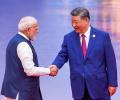
For India, China's Indian Ocean power projection, maritime domain awareness, dual-use ports, underwater surveillance, antisubmarinewarfare, naval exercises with Pakistan, pose considerable pressure, depleted India's strategic depth and marginalises Indian role, points out Srikanth Kondapalli.

Modi's comments on underlining the importance of ensuring the safety of seafarers came against the backdrop of growing anger in India over the killing of the three Indian crew members in a US military attack on a merchant ship off the coast of Oman last week.

Sanfida Nongrum's second-half strike sent India into the SAFF Women's Championship final, but coach Crispin Chhetri criticised his side's attitude and admitted Bhutan 'deserved to win' after a scrappy 1-0 semi-final victory.

While the Andaman and Nicobar islands serve as a vital, stationary asset for projecting power in the Indian Ocean, referring to them as an unsinkable aircraft carrier ignores key military and geopolitical limitations, explains Commodore Venugopal Menon (retd).

Five-time champions India booked their place in the final of the SAFF Women's Championship with a hard-fought 1-0 victory over a resolute Bhutan in the second semifinal in Margao on Wednesday.

The US Navy seized an Iranian-flagged cargo ship in the Gulf of Oman, escalating tensions as ceasefire talks face uncertainty. The incident raises concerns about the fragile ceasefire and the ongoing blockade of the Strait of Hormuz.

The escalating conflict in West Asia has resulted in 19 ships carrying essential energy resources for India being stranded in the Strait of Hormuz, raising concerns about potential disruptions to the country's energy supply.

India significantly increased its crude oil imports from Russia and the United Arab Emirates in June, securing supplies as the Strait of Hormuz began to reopen, with Russian barrels remaining attractive due to discounts and UAE supplies offsetting earlier uncertainties.

India has denied making any payments to Iran to secure safe passage for its vessels through the Strait of Hormuz, following reports that Indian vessels were fired upon in the region.
India granted emergency docking to an Iranian ship, IRIS Lavan, in Kochi due to technical issues, accommodating its crew amidst regional naval activity and tensions.

Despite Iran allowing 'non-hostile vessels' through the Strait of Hormuz, marine insurance premiums are expected to remain elevated due to persistent high-risk classifications and ongoing geopolitical tensions, with experts cautioning that the threat of attacks and collateral damage still exists.

Government sources have clarified that a passport has never been considered proof of citizenship in India, a stance consistent for the past 12 years and rooted in the Passport Act 1967. This clarification, reiterated by the Ministry of External Affairs, has drawn criticism from opposition leaders and public figures.

An Indian-flagged LPG vessel successfully transited the Strait of Hormuz, reducing the number of Indian ships stranded in the Persian Gulf. India is in talks with Iran to ensure safe passage for its tankers, and Indian refiners continue to purchase crude oil and LPG from Iran despite regional tensions.

'So far our production is not affected. But every day the situation prolongs, it does bring risks in terms of shipments getting delayed.'

Prime Minister Narendra Modi urged US President Donald Trump to prioritise the safety of Indian seafarers in the Strait of Hormuz during the implementation of Washington's proposed Iran peace deal, as both leaders focused on repairing strained bilateral relations at the G7 summit.

Amidst rising Middle East tensions, External Affairs Minister S Jaishankar highlights India's strategic dialogue with Iran to safeguard maritime traffic through the Strait of Hormuz, ensuring India's energy security and continued oil trade.

Iran's representative in India, Abdul Majeed Hakeem Ilahi, describes the ongoing tensions between Iran and the US-Israel alliance as a state of 'no war, no peace,' calling for an immediate halt to the conflict and questioning the lack of pressure on the US and Israel to cease aggression.
At least 101 people are missing and 78 are injured after a suspected submarine attack on an Iranian naval ship off Sri Lanka's southern coast on Wednesday, Reuters quoted sources in Sri Lanka's Navy and defence ministry as saying.

External Affairs Minister S Jaishankar has emphasised India's commitment to safe maritime transit and condemned attacks on merchant shipping amidst the ongoing West Asia conflict and global energy market disruptions.

'The flip side of this is that he won't hesitate to call out India if he thinks its policies are hurting US economic interests or border US foreign policy goals.'

The family of Dixit Solanki, an Indian seafarer killed in a suspected attack on a merchant vessel off the coast of Oman, has filed a petition in the Bombay High Court seeking the return of his mortal remains.

A lesson for India is to clearly define objectives beforehand, so that the adversary or other parties do not attempt to mitigate them midway.

Major General Amir Hatami, commander-in-chief of the Iranian Army, condemned the attack on the vessel, one of the country's newest warships, which occurred while it was returning from a military exercise.

A senior government official confirms that Indian vessels do not require permission to navigate the Strait of Hormuz, despite regional tensions. Several Indian ships, including LPG tankers, have safely crossed the strait, ensuring continued supply of essential commodities to India.
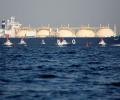
Iranian Deputy Foreign Minister Kazem Gharibabadi has urged India to take the lead in bringing peace to West Asia, highlighting the UAE's role in stalling BRICS consensus on the conflict. Gharibabadi also discussed a new framework with Oman for merchant vessels passing through the Strait of Hormuz.

India summoned the Iranian envoy after two Indian vessels had to reverse course in the Strait of Hormuz following an incident of firing by Iran's Revolutionary Guards.

Hundreds of Indian seafarers are stranded on vessels carrying crude oil, LPG, and LNG in the Persian Gulf due to the ongoing conflict in the Middle East, causing disruptions to India's energy supplies.
